|
Swords, Quivers, Bows & Arrows
|
THE
ARCHER |
|
HUNTING
DAGGER: Beech
wood blade, sisal rope guard, jute webbing handle, our smallest toy at
24 cm / 9.5" long approx. Often
favored
for the youngest in the family.
Historically:
A secondary blade more for hunting or feasting than fighting. Used
throughout history, from about 500BC onwards. Every warrior would
have had some such tool.
Order
Code: R-700-01
Price: US$17.50

|
|
CROSSQUILLAN
SWORD WITH SHOULDER BELT:
Beech wood blade, sisal rope guard, birchwood
ball pommel, jute webbing handle, jute webbing baldrick. A good size
at 48 cm / 19.5" long approx. Its baldrick (shoulder belt) adds
greatly to the play value of this toy. Crossquillan is pronounced
cross-kwil-lin.
Historically:
Crossquillans of similar form were used from the late Roman and Dark ages
and were in common use until the mid 16th century and last used in the 17th
century.
Such swords were worn by archers in the great armies of the middle ages.
Order
Code: R-700-02 Price:
US$28.50

|
| BOW +
2 Arrows:
Beech wood bow, jute webbing handle, cotton string, beech wood arrows, supple plastic heads
4.5 cm diameter / 1 3/4"
diameter, 32 cm / 13" in length.
At over 92 cm / 36" long approx., this has to be seen as a longbow
rather than the usual small toy bow. Customers often comment on
their preference for our very safe, "large", clear arrow heads
as opposed to the smaller red rubber heads.
Historically:
Bows, as hunting tools, have been used since before recorded history.
For the Early Scots, Anglo-Saxons and Vikings, bows were not just for
hunting; they were the first weapon used when boarding ships after they
became grappled. By the end of the 13th century, archers from the British
Isles were, without doubt, the best in Europe. By the mid-14th
century, the
King of France had a body guard of Scottish Archers. At that time,
Welsh and English longbow archers in their Plantaginate king's armies won
many a European battle. Even before swords clashed, their rain of
arrows (20 arrows each per minute) stopped all in their sights. As
late as the 17th century, during the covenanter war and then civil wars, castle
garrisons used longbows as an effective weapon of defense.
Order
Code: R-700-03 Price:
US$25.00

|
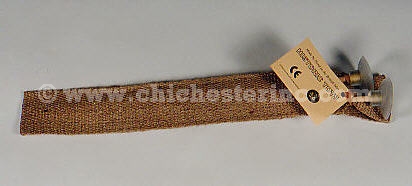
| QUIVER
+ 2 Arrows:
Jute webbing 36 cm / 14.5" long quiver, beechwood arrows, supple plastic
heads 4.5 cm diameter / 1 3/4" diameter, 32 cm / 13" in length. A must for any young archer.
Not only does this quiver come with two arrows but it will hold at least 2
or 3 more. "No one wants to run out of ammo!" The quiver
has a loop so it can be hung on a belt.
Order
Code: R-700-04 Price:
US$17.50

|
|
THE
DARK AGE WARRIOR |
SCRAMASAEX
LONG KNIFE:
Beech wood blade, sisal rope guard, jute webbing handle.
A most unusual short sword at over 36 cm / 14" long approx.
Historically:
The preferred personal blade of the Saxon - c. 300AD to 1100'sAD - even
when not at war an Anglo-Saxon would wear his Scramasaex Long Knife, a blade so much a part
of his dress that its name meant Saxon. The Scramasaex Long Knife was adopted by
Vikings - c. 875AD to 1066AD, as a secondary blade, worn across the lower
abdomen. With the Vikings, the Scramasaex Long Knife was taken as far west as
Vineland (North America).
Order
Code: R-700-06 Price:
US$25.00

|
ROMAN
SPATHA
BROAD SWORD:
Beech wood blade, sisal rope guard, jute webbing handle.
A delightful wooden sword at over 48 cm / 20.5" long approx.
Desired by adults as much as children.
Historically:-
Called the spatha by the Imperial Romans and used by their own Celtic
provincial cavalry as early as their invasion of Britain in 43AD.
Romano-British - c. 250AD to 600AD - used this sort of sword with infantry
as well as cavalry. Anglo-Saxon - c. 300AD to 1100'sAD - and Viking
heroes - c. 775AD to 1066AD - would have had a beloved sword of this type,
giving it a name like 'Foe Slayer'. With a sword like this the great
McAlpine united the Picts and Irish Scottae into one nation, and so
Scotland was born.
Order
Code: R-700-07 Price:
US$30.00

|
| WARRIOR'S
BROADSWORD Approximately 48 cm / 19" long
Historically, this
was the sword of the dark age warrior and then later of the medieval
castle guard. They were prized by all warriors and often given as gifts
from a lord to his bravest of followers. In myth and tale, only a warrior
armed with his broadsword could defeat the monster when it attacked the
Mead Hall, or the dragon when it enslaved the maid. A smaller sword would
not be able to cut down the thorny vines in wild woods.
Order
Code: R-700-14 Price:
US$30.00

|
|
THE
MEDIEVAL KNIGHT |
|
KNIGHT'S
BROAD SWORD:
Beech wood blade, sisal rope guard, jute webbing handle.
A real 'King Maker' desired by children of all ages, at about 60 cm / 23.5" long.
Historically:
First used by the richest of Norman knights among the 11th century
Crusaders, this sword became commonly used by knights in the proceeding Plantaginate
dynastic period - c. 1150AD to 1485AD. Their romantic stories told
of magic broad swords like 'Excalibur'. This sword had evolved from
the older spatha broad sword: the guard quillans had grown giving
greater protection, the pommel had become swept back enabling more fluid
movement from the wrist, and the point had become more tapered reducing
its weight. Normans used war and political marriage for over 15
decades after their invasion of England in 1066AD to become the masters
of many parts of Scotland, Wales and Ireland. All but the most
remote chiefdoms became ruled over by descendants of those early Norman
Lords. This sword came to all parts of the British Isles as the
local upper class became Normanised.
Order
Code: R-700-09 Price:
US$26.00

|
|
THE
HIGHLANDER |
WARRIOR'S
BROAD
DIRK:
Beech wood blade, sisal rope guard, jute webbing handle.
Above 24 cm / 9.5" long approx. Just what it says, a broad
bladed little wooden dagger.
Historically:-
First made from bronze about 1500BC, in ancient times, the broad dirk
was a sign of wealth and power, so would always be worn by tribal
chiefs and heroic champions. By 500BC, this type of dagger was being
forged from iron. This weapon never really disappeared among the
Scots; even today highlanders know of this ancient blade as 'the Dirk'
or, if it has a black handle, 'the Sgian Dubh'.
Order
Code: R-700-10
Price: US$20.00

|
|
CLAYMORE
GREATSWORD:
Beech wood blade, sisal rope guard, large birchwood ball
pommel, jute webbing handle. The ultimate wooden sword at about 75
cm
/ 29.5" long approx. Desired by many adult theatrical groups
as a prop. This is a truly great model of a legendary sword.
Historically:-
Although this sword came into existence in the late middle ages, it really
was a sword of the Renaissance, often seen in the hands of a sword master.
On the field of battle the greatsword was used to break tight enemy
polearm formations. Because of the persistence of clan warrior
culture in the highlands of Scotland, the skill required to wield this
sword remained for over a century longer than the rest of Britain.
In the early Jacobite wars of the late 17th century, highland clansmen, with
incredible prowess and dreaded effect, cut swathes through the lines of
Redcoated English Infantry.
Order
Code: R-700-11
Price: US$37.50

|
|
THE
RENAISSANCE SWORDSMAN |
|
POIGNARD
SHORT SWORD: Beech wood blade, sisal rope guard, birchwood ball
pommel, jute webbing handle. This toy sword is approximately 36 cm / 14.5" long.
Historically:-
Used from the late Middle Ages c. 1400AD onwards, to as recently as
1850AD. A quality defensive blade, becoming the 'main gauche' or
left-hand blade when used with a longer right-hand weapon (such as our
Crossquillan or Hanger). This was the short sword (not a dagger!)
used in the Renaissance 'Sword and Dagger' martial art. The poignard
became the sword of royal court dress, where it remained until the 19th
century.
Order
Code: R-700-12
Price: US$25.00

|
|
HANGER/CUTLASS
+ shoulder belt: Beech wood blade, sisal rope guard, jute webbing
handle. At about 48 cm / 19" long approx., this toy is
often favored by parents due to the baldrick (shoulder belt), and also because of the protective nature of the guard.
Historically:
Used since the mid-16th century, this sword had become common throughout
Britain by William Shakespeare's day. In the early 17th century, 'New World'
colonists carried such swords, as they ventured for a new life.
Later that same century Scottish Covenanter and English civil war soldiers
were both fighting with hangers. From the 17th century up as late as the end
of the 19th century, soldiers throughout Europe and North America would have been
issued with hangers such as this one.
Order
Code: R-700-13
Price: US$26.00

|
| RENAISSANCE
GRAND POIGNARD:
This toy sword is approximately 58 cm / 23" long.
Historically: In
the late-15th century, this sword developed from the medieval Arming
Sword which was no longer used for battle (a knight's second blade had
become a Gladius). A Poignard would have been worn at all times by
a gentleman - to not wear it was to be undressed. It was most likely
to be used in duels of honour, when a gentleman would not be attired in Full
Cuirass (wearing Armour). Its strong, flexible, long, thin blade
was more desirable than a heavy broad bladed sword, to deliver a quick
thrust that could not be easily fenced (passed off/blocked).
From swords like this the martial art of sword fencing developed as a way
to train young gentlemen with this sword.
Order
Code: R-700-20
Price: US$28.00

|
ROMAN
GLADIUS:
"Legionary's Gladius" sisal rope guard, beechwood blade.
approximately 48 cm / 15.5" long.
Historically:
Encountered, literally at the sharp end, by Roman legions warring in
Spain, the Gladius Hispanicus was soon adopted by all Rome's
legions (they had used more Classical swords before then). Compared to
classic short swords, this was a much stronger sword designed not to be
wielded about but thrust forward. By the time of their conquest of
Britain, many generations of legionaries had used this sword, developing
close formation combat with rectangular Scutum shields. Rome had a
vast empire by 236 AD and could no longer afford highly trained legions;
this sword was then replaced by the longer cavalry Spatha
Broadsword as fighting formations became more open.
Order
Code: R-700-25
Price: US$20.00

Click on above
picture for larger view.
|
| BALDRICK
(SHOULDER BELT)
The baldrick is a
great addition to role-play; when a player puts it over their shoulder they
feel more in character. One sure way to prevent leaving one of these
desirable toys about the neighborhood is to hang it about the body when
not battling the foe. Note: this shoulder belt will take both role-play
swords and those from our historic sword range. The baldrick fits on
all of the larger swords.
Order Code:
R-700-23 Price: US$6.50
Click on above picture for a larger view. |
|
BRONZE
AGE CHIEF'S DIRK
Approximately 25 cm / 9.75" long
Bronze
dirks similar to this are the oldest known metal blades. They date from as
long ago as 1,500 years B.C.E. In ancient times a bronze dirk was more a
status symbol and ceremenial aid than a weapon. Although such blades may
have been worn by tribal chiefs in battle, the majority of weapons from
this period (apart from occasional bronze-tipped arrows) were made of
flint, wood, or antler.
Order Code:
R-700-26 Price: US$20.00

Click on above picture for a larger view.
|
ANCIENT
BROAD DAGGER
Approximately
26 cm / 10.25" long
Order Code:
R-700-15 Price: US$20.00

Click on above picture for a larger view.
|
ANCIENT
CELTIC BROAD SWORD
Approximately 58 cm / 23" long
Historically:
Weapons like this were being forged in iron by skilled swordsmiths of the
iron age celtic culture from about 500BC. Celtic nobles paid great respect
to their swords giving them names and having them blessed with magic.
Order Code:
R-700-16 Price: US$30.00

Click on above picture for a larger view.
|
KNIGHT'S
BROAD DAGGER Approximately 30
cm / 12" long
Historically;
Men of rank from Man-At-Arms to Noble Knight always displayed their
position by the way they dressed and items they carried about them. Lords
had dirks with handles encrusted with gems. This was also a weapon of last
resort in battle.
Order Code:
R-700-18 Price:
US$20.00

Click on above picture for a larger view.
|
KNIGHT'S
FALCHION Approximately 47 cm /
18.5" long
Historically;
Falchions evolved from the Celtic short sword, becoming longer and longer
as the middle ages progressed. By the early C14 Falchions had become
common amongst wealthy men-at-arms and knights. The Falchion was sometimes
also called a Cleaver but unlike the Cleaver, the Falchion usually had
longer quillans (guards) and a considerable longer blade.
Order Code:
R-700-19 Price: US$25.00

Click on above picture for a larger view.
|
ARCHER'S
COMPANION SWORD Approximately
35 cm / 14" long
Historically:
these swords were carried by many travellers in medieval times. More a
weapon to keep you safe than start a fight. Many foot soldiers also
carried this sword as a second blade. In myth and tale: one thing is
certain, in wild woods and rocky canyons where thieves and rogues abound
every traveller needed a trusty sword to ward off those who would do no
good.
Order Code:
R-700-21 Price: US$17.50

Click on above picture for a larger view.
|
ANCIENT
PUGIO DAGGER Approximately 25
cm / 9.75" long
Historically:
This was the last weapon of defense and marching-camp handy tool all in
one. Many a Pugio was the savior of an all but defeated legionary. After
about 180AD, only senior officers from Centurions up carried Pugios.
24cm/9.5" long
Order Code:
R-700-22 Price: US$17.50

Click on above picture for a larger view.
|
|